|
|
|
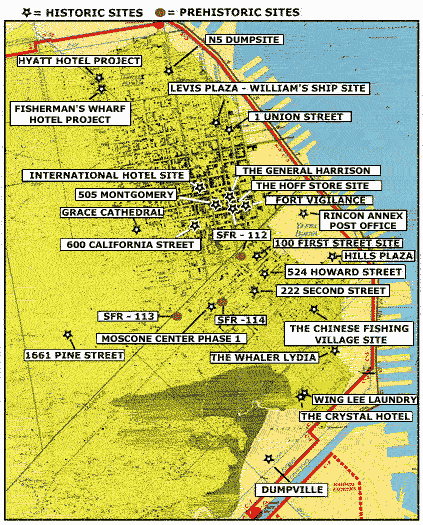
| Located
near the corner of First and Minna streets, this deposit is
composed of the artifact-laden remains of several short-lived
Gold Rush structures. The site is the oldest and best-preserved
Gold Rush era archaeological deposit in the south of Market
Street area. Between 1849 and 1850, the 100 First Street Site
was at the center of the 'Happy Valley' community,
a sprawling, chaotic, and ever-changing Gold Rush settlement
abutting the Bay shoreline along today's First Street.
|
 |
 |
| |
 |
|
 |
|
Happy
Valley was filled with thousands of immigrants, transients
and squatters who were waiting to travel to the Sierra Nevada
gold fields. A total of 329 Chinese ceramics were recovered
during excavation, and proved to be the material possessions
of residents who occupied the shanty located at 100 First
street. A close analysis of the recovered artifacts, despite
the large number of Chinese ceramics, revealed that the residents
were not Chinese but Anglo-American and possessed the ceramics
either as curiosities or as convenient, available material
necessities. The 100 First Street site provides an example
of the Chinese immigrants' infiltration into white
American culture.
|
|