|
  |
|
|
| The
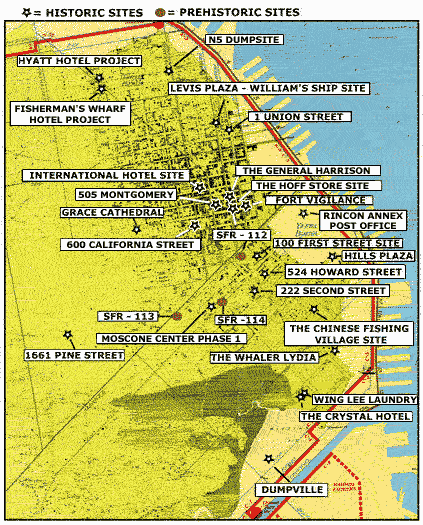
Chinese Fishing Village, existing from 1850 to the mid-1860's,
is located along the southern shoreline of Rincon Point. Often
referred to as the Bayside Village, it is the site of one of
California's first Chinese fishing villages, of which there
were many by the later 19th Century. Archeo-Tec's 1987 excavation
of the site offers an interpretation of how marginalized Chinese
immigrants adapted to life in the United States. As a result
of Anglo-American prejudices and resentments toward the Chinese
immigrants (who were willing to work for very little money) the
Chinese sought economic endeavors where they would encounter
minimal competition with the whites. |
 |
|
| |
 |
|
 |
|
|
| |
 |
|
| Thus,
they formed commercial fishing co-operatives where Chinese immigrants
lived and worked together. Here, residents caught and packed
abalone, fish, and shrimp to sell publicly and trade with other
Chinese merchants for food and other Chinese goods. This self-contained
system of barter allowed the Chinese community to preserve much
of their material culture within an adverse environment. The
wide range of cultural materials recovered from this village
included imported Chinese items, along with large deposits of
abalone shells, and the unexpected remnants of several Gold
Rush vessels. Ambitious Chinese workers dismantled these vessels
for neighboring ship breaker Charles Hare. (See Hills Plaza
for more regarding Charles Hare's ship breaking.) |
|